Tuesday, November 8, 2011

Graphs of Other Trigonometric Functions


- Cosecant graphs have NO x- intercepts


- The vertical asymptote is where sin = 0


- The period is


- Secant graphs have NO x- intercepts


- The vertical asymptote is where cos = 0


- The period is


- Where sin = 0, tan is the x- intercept

- Where cos = 0, tan is the vertical asymptote


- The Period is


- Where cos = 0, cot is x- intercept


- Where sin = 0, cot is the vertical asymptote


- The period is


Thursday, November 3, 2011

Trigonometric Functions of Any Angle

In this section, the definitions of trigonometric functions are extended to cover any angle.

In trigonometry, we tend to think of an angle as created by a rotating ray. The beginning position of the ray is called the initial side. Usually, the initial side coincides with the positive x-axis; angles with such an initial side are said to be in standard position. The post-rotation position of the ray is called the terminal side. The measure of the angle is a number which describes the amount of rotation. If the rotation of the ray was clockwise, the angle measure is a negative number; if the rotation was counterclockwise, the angle measure is positive.


An angle θ in standard position creates a right triangle on the coordinate axes as follows:

  1. Choose a point P0=(x0, y0) on the terminal side of the angle.
  2. Draw a vertical line from P0 to the x-axis (note: this line is perpendicular to the x-axis).
  3. The resulting right triangle with vertices (x0, y0), (x0, 0), (0,0) is called the reference triangle for the angle θ


The vertical side of this triangle has length y0; the horizontal side has length x0; the hypotenuse is the distance from P0 to the origin, or


Trigonometric Functions of any angle


*Note: Notice that tan(θ) and sec(θ) are not defined when the terminal side of the angle is vertical; Also cot(θ) and csc(θ) are not defined with the terminal side of the angle is horizontal.


Evaluating Trigonometric Functions When Given a Point

To evaluate a trigonometric function just take the point given on the terminal side of the angle and plug it into the formula for the function you solving listed above in the table. You can think of r as the hypotenus of the reference triangle so

Sine and Cosine Graphs

Amplitude: is half the distance between the maximum and minimum on the graph. (height of one wave)

- Amplitude = |a|


Period: the length from one crest to the next (wavelength)

- 2π/b


Translations: y= a x sin (b (θ - c)) + d


• Y creates a vertical change

• A creates a vertical change. The larger the number, the longer the stretch becomes

• B creates a horizontal change. The larger the number, the more compressed the graph becomes.

• θ creates a horizontal change

• C creates a horizontal change. It shifts to the left if positive, and the right when negative.

• D causes the entire function to shift up or down Y creates a vertical change


Phase Shift: Sin(θ + 2π) = Cos


Sine Graph:

  • Crosses through the origin
  • Amplitude is 1
  • Period is 2π


sinx.gif


Cosine Graph:


  • Starts at 1
  • Amplitude is 1
  • Period is 2π


trig_cosine.gif

Monday, October 31, 2011

· Identities: an equation that is always true.
o Reciprocal Identity:
§ Ex)\[sin\theta =1/csc\theta \]
· (applies to all six)
o Quotient Identity:
§ Ex)\[tan\theta =sin\theta /cos\theta \]
· (applies to all six)
o Even Odd Identities
§ Ex)\[sin(-\theta )=-sin\theta \]
· (applies to all six)
o Pythagorean Identities
§ Three different identities
· 1) \[sin^2\theta +cos^2\theta =1\]
· 2) \[tan^2\theta +1=sec^2\theta \]
· 3) \[cot^2\theta +1=csc^2\theta \]
· Solving Identities:
o Ex) \[(cot\theta +csc\theta)(tan\theta -sin\theta)=sec\theta -cos\theta \rightarrow (1-cot\theta)(sin\theta)+(csc\theta)(tan\theta-1)\rightarrow -(cos\theta /sin\theta )(sin\theta )+(1/sin\theta)(sin\theta /cos\theta )\rightarrow -cos\theta +1/cos\theta \rightarrow sec\theta =cos\theta =sec\theta -cos\theta \]

Thursday, October 27, 2011

Ratios

sine x = (side opposite x)/hypotenuse

cosine x = (side adjacent x)/hypotenuse

tangent x = (side opposite x)/(side adjacent x)

In the figure below, sin A = a/c, cosine A = b/c, and tangent A = a/b.


Accompanying Figure

alg2_table.gif

Reciprocal Ratios

cotangent x = 1/tan x = (adjacent side)/(opposite side) 

secant x = 1/cos x = (hypotenuse)/(adjacent side) 

cosecant x = 1/sin x = (hypotenuse)/(opposite side)

Cofunctions

sin x = cos (90o - x) 

tan x = cot (90o - x) 

sec x = csc (90o - x) 

cos x = sin (90o - x) 

cot x = tan (90o - x) 

csc x = sec (90o - x) 

Example:

1. Problem: Find the function value of

cot 60o.

Solution: Use the cotangent's cofunction

identity to rewrite the problem.

tan (90o - 60o)

tan 30o

The tangent of 30o is


(SQRT(3))/3

Monday, October 24, 2011

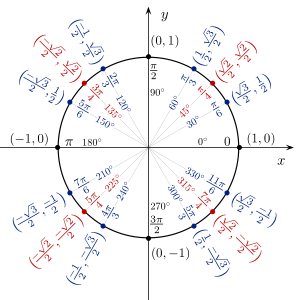
Section 4.1 Radian and Degree Measure

Angles


Radian Measure

Definition of a Radian
One radian is the measure of a central angle θ that intercepts an arc s equal in length to the radius r of the circle.


Example 1: Finding Coterminal Angles
Find a positive and a negative angle coterminal with a  angle.
A  angle and a  angle are coterminal with a  angle.

Thursday, October 20, 2011


Section 2.7 Graphing rational functions


Graph f(x)=x/x^2-x-2
set the numerator equal to zero in order to find the x-intercepts

x-intercept = 0

plug in a zero to find the y-intercepts

y-intercept= 0

factor the denominator to find the vertical asymptotes

(be sure to write them as an equation of a line)

(x-2)(x+1)

x=2 x=-1

The horizontal asymptote is y=0 because the numerator degree is less than the denominator degree

Graph the function

(the graph will end up looking like the graph on the right)


Rules for horizontal asymptotes:

1. just use the leading term because the other terms are insignificant

2. If the degrees are the same for the leading term, just divide the numerator by the denominator

3. If the degree of the numerator is greater than the degree of the denominator, there is no horizontal asymptote

4. If the numerator degree is less than the denominator degree, the horizontal asymptote is y=0

5. A line can cross the horizontal asymptote in the middle of the graph

6. written as y=


Vertical asymptotes are where the denominator is equal to zero

-you can never cross the vertical asymptote

-written as x=


Be sure to watch out for holes and zeros of multiplicity

F(x)= x (x-3)/ (x^2-x-2)(x-3)

(x-3) is in the numerator and denominator so you cross them out leaving a hole in the graph at x=3

When there is a zero of multiplicity of two, the graph will look exactly the same as the graph on the other side of the asymptote.


F(x)= x/(x-3)

x-intercept= 0

y-intercept=0

vertical asymptote is x=3

horizontal asymptote is y=1